

Blog
Moissanite vs Diamond: A Real Buyer’s Guide

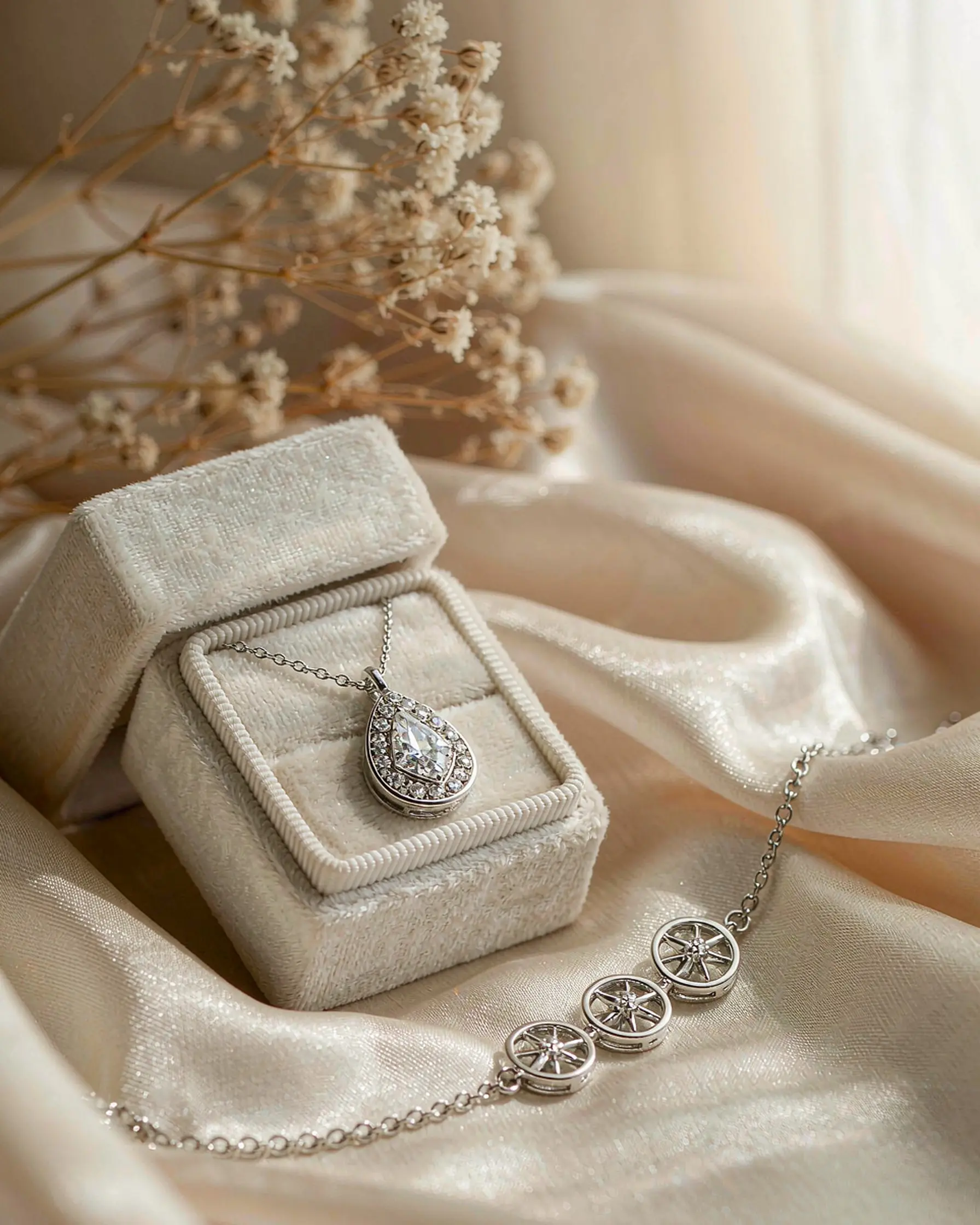
Moissanite and diamond look almost identical in a jewelry box and behave very differently under a loupe — and that gap is exactly where good buying decisions are made. Both are real gemstones with their own chemistry, their own strengths, and their own price tags. This guide walks through the differences that actually matter for everyday wear, so you can choose the stone that fits the piece you have in mind.
What Moissanite Actually Is
Moissanite is silicon carbide (SiC), a mineral first identified in 1893 by the French chemist Henri Moissan while he was studying rock from a meteorite crater in Arizona. He believed he had found diamond; laboratory analysis showed a compound of silicon and carbon instead. Natural moissanite is so rare that essentially every moissanite sold in jewelry today is created in a lab, where the crystal is grown under controlled heat and pressure and then cut like any other stone.
That origin is worth stating plainly, because it gets misread in both directions. Moissanite is not glass, and it is not cubic zirconia. CZ is zirconium dioxide and sits around 8 to 8.5 on the Mohs hardness scale; it also tends to cloud and scratch over years of wear. Moissanite scores 9.25, holds its polish indefinitely, and keeps its optical properties. It is simply a different stone from diamond — one with its own identity rather than an imitation of another.
Moissanite vs Diamond: The Numbers
Diamond is pure carbon, crystallized in a dense tetrahedral lattice. Moissanite is a compound with a different atomic arrangement, and almost every measurable property follows from that. Here is the short version, using published gemological values.
- Hardness: Diamond 10 on the Mohs scale, moissanite 9.25. For practical purposes both resist everyday scratching, and moissanite outranks sapphire and ruby, both at 9.
- Refractive index: Diamond 2.42, moissanite 2.65 to 2.69. A higher index means more light bent back to the eye, which is why moissanite can look brighter in low light.
- Dispersion (fire): Diamond 0.044, moissanite 0.104 — more than twice as high. Moissanite splits light into spectral color far more strongly, so it throws visible rainbow flashes where a diamond returns mostly white brilliance.
- Double refraction: Diamond is singly refractive; moissanite is doubly refractive. Under 10× magnification you can see doubled facet edges, a slight softness that is hard to spot with the naked eye in smaller stones.
- Weight: Specific gravity is about 3.52 for diamond and 3.21 for moissanite, so at the same face-up size moissanite weighs roughly a tenth less — one reason it is usually sold by millimeter rather than carat.
How to Tell Them Apart
A trained eye needs seconds, not minutes. Gemologists look for the doubled facet edges under a loupe, and they use testers: moissanite conducts heat well enough to pass a simple diamond heat probe, so a dual tester that also checks electrical conductivity is the reliable tool. Certification is the other dividing line. Mined and lab-grown diamonds are graded against the 4Cs by laboratories such as GIA and IGI. Moissanite is not graded by those labs, and its quality grades come from the producer instead.
What You Actually See
In daylight the difference comes down to character rather than quality. A diamond tends to read as crisp, white, and restrained; a moissanite reads as lively and rainbow-lit, especially in a halo, a pavé band, or a cluster where several stones fire at once. Neither is better — they are simply different visual signatures, and most buyers know which one they want within a glance.
Color has improved sharply. Modern colorless-grade moissanite is comparable to a D-to-F diamond to the naked eye, and the old yellow or green cast is largely a thing of the past in small and mid-size stones. In stones above roughly two carats, a faint tint can occasionally show under warm indoor light, so it is worth viewing a large stone in more than one lighting condition before you commit.
Cost, Value, and Certificates
Price is where the two stones part company most dramatically. Per carat, moissanite typically runs a small fraction of a natural diamond and comfortably below a lab-grown diamond of similar visual performance — which is why a buyer on a set budget can often choose a much larger moissanite or a fuller setting instead of a modest diamond.
The trade-off is resale. Diamonds hold a recognized secondary market and a certification trail; moissanite has almost no resale value and no independent grading. If you are buying an heirloom engagement piece where the certificate and future value matter, that points to diamond. If you are buying a piece to wear, enjoy, and replace without anxiety, the maths often points the other way.
Which Stone Belongs in Your Jewelry Box?
A practical way to decide is to match the stone to the job. For pieces worn hard and often — a bracelet you never take off, a pendant that goes from desk to dinner, jewelry that travels in a carry-on — moissanite’s hardness and price make it an easy yes. For a single ceremonial piece bought once and kept for decades, diamond’s certification and resale carry more weight.
If you want the moissanite look in sterling silver, a few pieces make the choice simple. The moissanite star bracelet in 925 sterling silver sets a 1 carat stone in a four-prong star design — polished, light on the wrist, and built for daily layering. For the neckline, the teardrop moissanite pendant necklace hangs a single cut stone on an O-link cable chain at the collarbone, a shape and length that works with almost everything. And because moissanite looks its best with a calm supporting cast, the tiny 999 fine silver ball stud earrings (3 mm to 5 mm, in silver, white gold tone, and rose gold tone) are the least fussy way to finish a look without competing with the main stone.
A Short Care Note
Moissanite is chemically stable and will not cloud, fade, or change color with age, so caring for a moissanite piece is mostly about the metal around it. Sterling silver is 92.5 percent silver and 7.5 percent copper, and that copper reacts with sulfur and moisture in the air to form tarnish — a surface film, not damage. A soft polishing cloth brings the shine straight back.
- Put jewelry on last, after lotion, perfume, and hairspray have dried.
- Clean with lukewarm water, a drop of mild soap, and a soft cloth; dry fully before storing.
- Store pieces separately in soft pouches so harder stones cannot scratch softer settings or neighboring metal.
- Remove jewelry before swimming, showering, or handling household cleaners.
Start With One Piece
Moissanite and diamond are both excellent stones; they simply answer different questions. Choose the one that matches what the piece has to do, and let the sparkle follow. The moissanite bracelets, pendants, and sterling silver everyday pieces mentioned above are all in the shop — a good place to start is one piece you will genuinely wear this week.