
Blog
Chinese Coin Necklace: Meaning, History and How to Wear It

The Chinese coin is probably the most reproduced shape in jewelry and the least understood. Designers borrow it for the geometry — a circle with a square in the middle — without knowing why the hole is square, what the four characters around it meant, or why the coin was strung rather than carried in a purse. The answers explain most of what the motif still does on a chain today.
Round Heaven, Square Earth
The standard reading of the shape is cosmological. A round coin with a square hole stands for tian yuan di fang — round heaven, square earth — the old Chinese model of the universe, with the emperor’s authority at the centre holding the two together.
That interpretation is traditional rather than proven. Some historians argue the hole is simply practical. Both are probably true: the shape was chosen for a reason and then given a meaning that made it worth keeping.
The practical reason is strong. Coins were cast in linked trees, then broken apart and filed, and a square hole grips a square-shanked tool so the coin does not spin while the edge is cleaned. The same hole let a thousand coins be strung on one cord, which is how large sums were carried and counted.
A Short History of the Cash Coin
Round coins with a central hole appeared during the Warring States period and became standard under the Qin dynasty in 221 BC, when the banliang was introduced as a unified currency. The Han wuzhu followed in 118 BC and stayed in circulation for roughly seven centuries.
The design most people recognize today dates to 621 AD, when the Tang dynasty issued the Kaiyuan Tongbao. Its four characters were arranged around the square hole, two above and two below, reading top-bottom-right-left. That layout became the template for every later dynasty.
Coins stayed in essentially this form for more than a thousand years, through the Song, Yuan, Ming and Qing, with the inscription changing and, under the Qing, Manchu script added to the reverse. Cast cash coins were still in use in the early twentieth century. When they finally left circulation, the shape was already too familiar to disappear, and it moved into amulets, architecture, textiles and jewelry.
What the Coin Means Today
Three meanings survive in ordinary use.
Wealth, but not greed. A coin is money in its most basic form, so it stands for sufficiency rather than luxury. This is why coin motifs appear on everyday objects — bowls, tea trays, door knockers — rather than only on valuable ones.
Protection. Coins were hung above doors and on children’s clothing. The most common version today is a set of five Qing dynasty coins tied with red thread, one from each of five consecutive reigns, used to deflect bad luck. You do not need the antique coins themselves; a silver charm in the same shape carries the same intent for most wearers.
Continuity. In a Chinese household, an old coin is often the oldest object in the room. Wearing one is a way of keeping a link to a family or a place, which is why the motif travels well as a gift for someone living abroad.
Coin, Peace Lock or Jade
These three pendants are often grouped together as “lucky” jewelry, but they come from different traditions and suit different tastes.
| Motif | Origin | Meaning | How it wears |
|---|---|---|---|
| Coin with square hole | Currency, 4th century BC onward | Prosperity, protection, continuity | Flat and light; layers easily |
| Peace lock | Children’s amulet, changming suo | Long life, safety | Deeper profile; reads as a statement |
| Jade pendant | Ritual objects, Neolithic onward | Virtue, calm, status | Heavier; colour becomes the focus |
The coin is the easiest of the three to wear every day, because it is flat, small and uncolored. A peace lock pendant needs a neckline that can carry its depth, and jade asks for a wardrobe that can handle green.
Reading the Design Before You Buy
Most coin necklaces sold today are motifs, not antiques. That is fine — but the quality still varies enormously.
Look for a stated silver base. The Chinese coin pendant necklace lists 925 sterling silver for both the pendant and the O-chain, with a rose gold tone or white gold tone finish applied over the surface. That is the right order of information: the metal underneath first, the colour second.
Check whether the coin is solid or stamped. A stamped coin is a thin disc with a raised rim, and it dents at the edge. A solid piece holds its shape and feels cold and dense in the hand.
Look at the hole. The square should be cut cleanly with sharp corners. A rounded or off-centre hole is the fastest sign of an inexpensive casting.
Ask what the finish is. Rose gold tone and white gold tone are plating over silver, not solid gold. Plating wears at the high points first, which on a coin means the rim and the edges of the square.
How to Wear It
The coin sits best at the collarbone, where a circular pendant has room and the chain is not hidden by a collar. On most adults that means a chain around 40 to 45 cm.
On its own with a white tee, a linen shirt or a plain knit. The coin is the only decoration the outfit needs, and a round shape against a plain background reads clearly.
Layered under a shorter choker or over a longer chain. Keep the other pieces plain: two coin motifs at different lengths look repetitive, and a coin plus a large pendant looks cluttered.
With an open collar, where the coin falls into the V of the shirt. This is the most flattering position for a round pendant and the one that makes the piece look intentional rather than added.
On tone: the rose gold version warms against cream, brown and olive, and reads slightly vintage. The white gold version is cooler and sits better with grey, black and blue. Both are silver underneath, so the choice is about colour, not value.
The Drop and the Extra Coin
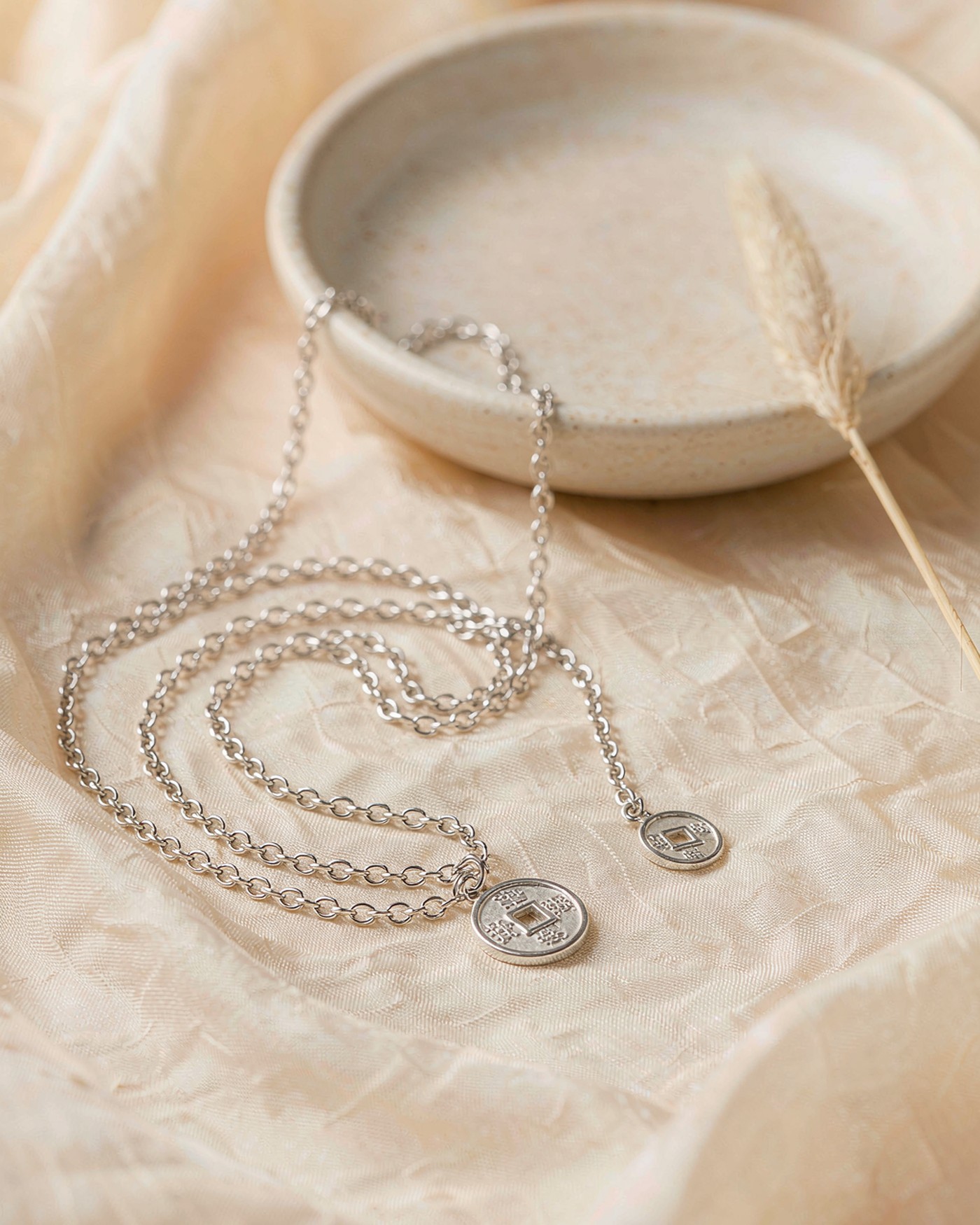
Many coin necklaces are not a single pendant on a chain. This one sets a small coin into the chain itself and finishes with a short drop that ends in a second, smaller coin — a detail borrowed from the tassel necklaces of the Tang and Song periods, where the hanging element was as important as the pendant.
The drop changes how the piece moves. A fixed pendant stays where the chain puts it; a drop swings slightly when you turn, which draws the eye and keeps the necklace from looking flat in photographs. It also means the chain has a front and a back: put the necklace on with the drop at the centre, not off to one side, unless you want the asymmetry on purpose.
Care for Plated Silver
Sterling silver with a tone finish needs slightly more care than plain silver, because two surfaces are involved.
- Wipe with a dry soft cloth after each wear. Skin oil dulls plating faster than it tarnishes silver.
- Keep perfume, lotion and hairspray off the metal. Alcohol is the fastest way to wear through a thin tone layer.
- Remove before swimming, showering and sleeping. Chlorine attacks both the plating and the silver.
- Do not use silver dip on a tone-finished piece; it can strip the colour as well as the tarnish.
- Store in a dry pouch with the chain fastened, away from other jewelry that could scratch the coin face.
When the plating eventually wears at the rim, the piece is still sterling silver underneath. Many people prefer the two-tone look that develops; if you do not, a jeweler can re-plate it.
Giving a Coin Necklace
The coin is a good gift when you want to say something about good fortune without making a speech. It suits a new job, a move to a new city, a graduation, or a friend starting a business.
It also works across generations, which is unusual in jewelry. A teenager reads it as a minimal gold-tone pendant; an older recipient reads the motif and knows what it is. That range is the reason the shape has outlived the currency by a century.
If you are buying for someone with a strong personal style, choose the finish to match the jewelry they already wear. If you do not know, white gold tone is the safer default. For a colour-led alternative in the same tradition, a hetian jade necklace carries the same idea in green nephrite rather than metal.
The Short Answer
A Chinese coin necklace carries a round coin with a square hole — heaven and earth, with the hole that once let a thousand coins be strung on one cord. It means prosperity, protection and continuity, and it is the most wearable of the traditional Chinese motifs because it is flat, small and uncolored. Buy 925 silver, check that the hole is cut cleanly, and wear it at the collarbone with a plain neckline.
Related Reading
- How to Wear Chinese-Style Jewelry Without a Costume Look
- Snowflake Necklace Meaning: Why It Became a Gift Staple
- Jasmine Flower in Jewelry: Meaning and Gift Occasions
- What Is a Tassel Lariat Necklace, and How Do You Wear One?
Browse the full collection of Chinese-inspired silver jewelry. Coin pendants, peace locks and jade, all set in 925 silver.