
Blog
Snowflake Necklace Meaning: Why It Became a Gift Staple

A snowflake is one of the few winter motifs that survives being made small. A reindeer at ten millimetres looks like a smudge and a snowman looks like a cartoon, but a six-point snowflake still reads as a snowflake at the width of a fingernail. That is why it has stayed in jewelry for more than a century while most seasonal charms come and go.
It is also why the motif makes a practical gift. It carries meaning without asking the recipient to share a religion, a birthstone or a favourite colour, and it does not need to know anyone’s ring size.
What a Snowflake Symbolizes
Three ideas attach to the shape, and they overlap.
Individuality. The claim that no two snowflakes are alike moved from science into common knowledge after Wilson Bentley photographed snow crystals in Vermont in 1885. A snowflake pendant borrowed that idea long before “personalized” became a marketing category. It is a way of saying you are not a type without engraving a name.
Impermanence. In Japan, snow is a standard image of mono no aware, the beauty of something that will not last. A snowflake is the version of that idea you can keep in a drawer, and it explains why the motif carries a quiet, slightly melancholy tone rather than pure festivity.
Winter itself. Not Christmas specifically. In the northern hemisphere the shape belongs to the whole season, which is why it still looks right in February when the trees have come down and the fairy lights have gone back into the box.
From Victorian Brooch to Collarbone Pendant
Snowflake jewelry existed in the Victorian period as diamond and paste brooches, usually pinned to a coat or a velvet ribbon at the throat. The shape suited the era’s taste for natural forms and its new fascination with microscopy.
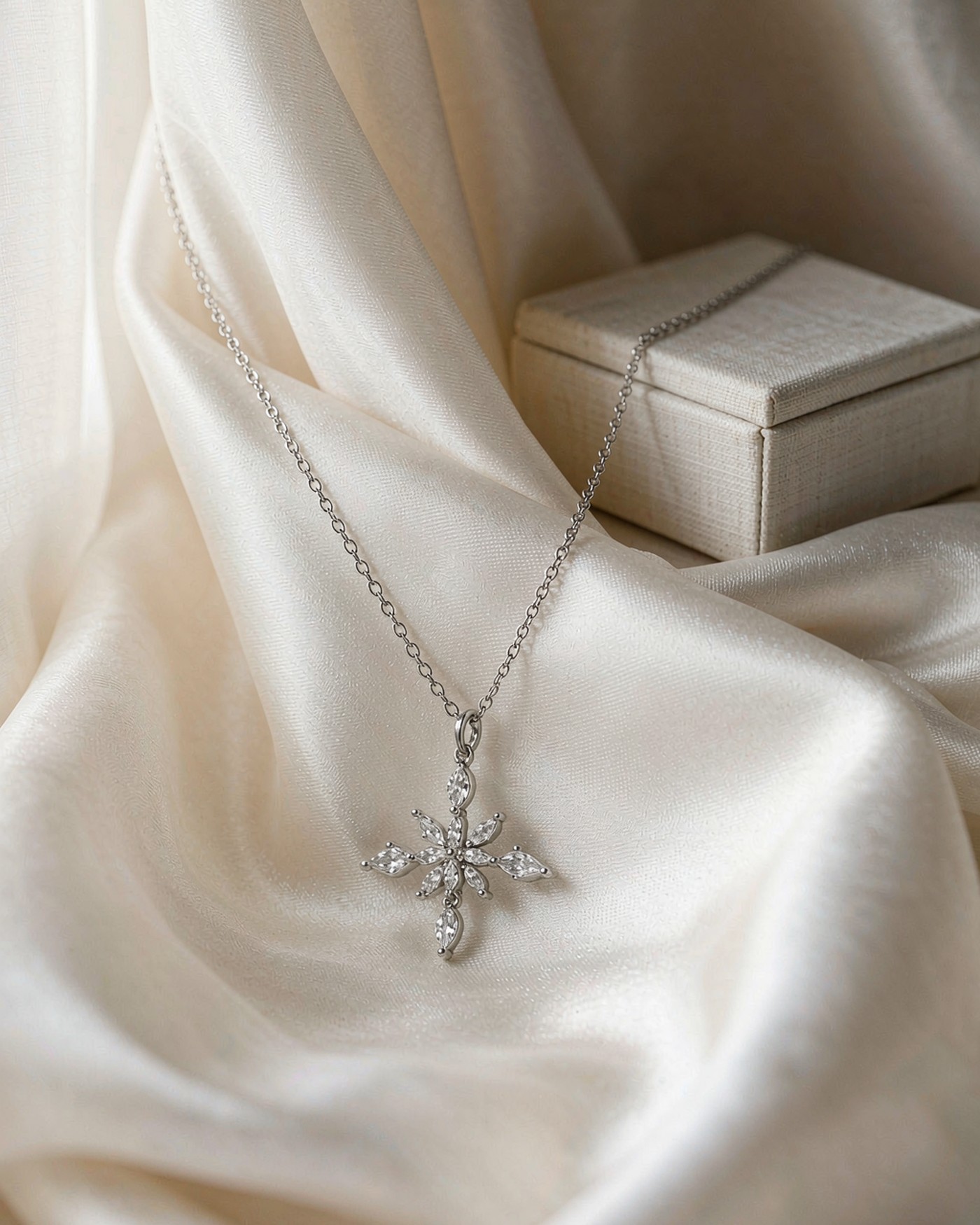
The modern version is smaller and simpler: one snowflake, often set with cubic zirconia, on a thin chain that lands at the collarbone. The change follows the general move in everyday jewelry from brooches to necklaces, and from formal occasions to daily wear. The sterling silver snowflake necklace in this collection is the current form of the idea: a six-point snowflake built from marquise-cut stones, on a 40+5 cm chain, made in 925 silver rather than a base metal with a silver wash.
Why It Works as a December Gift
December is a difficult month to buy jewelry for, for two reasons.
The first is the birthday problem. A friend born on 18 December has spent a lifetime receiving combined presents, and a snowflake does not read as tinsel. It has no Christmas tree, no Santa, no year printed on it, so it works as a birthday gift that happens to arrive in winter.
The second is the sizing problem. Rings need a size, bracelets need a wrist measurement, earrings need pierced ears and a metal the wearer can tolerate. A pendant on a 40+5 cm chain with an extender fits almost every adult neck, which makes it the lowest-risk piece of jewelry you can give someone you do not shop for often.
Timing matters more than most people expect. If the piece is meant to be worn on the day rather than opened after it, order in the first week of December. Shipping queues in the last ten days of the month are the reason gifts arrive in January.
What to Check Before You Buy
Two snowflake necklaces can look identical in a photograph and differ completely in how they age. These are the six things worth reading on a product page.
| What to check | Why it matters | What good looks like |
|---|---|---|
| Base metal | Decides whether the piece tarnishes in a month or lasts years | “925 sterling silver” on the pendant and the chain, not “silver tone” |
| Stone setting | Glued stones fall out; prongs hold | Visible metal prongs over each stone, closed back |
| Pendant width | Sets whether it reads delicate or costume | 10–14 mm for everyday; 18 mm and above becomes a statement |
| Chain length | Determines where the pendant lands | 40+5 cm, with a real extender rather than a long loose tail |
| Clasp | The first part to fail on a thin chain | Lobster claw; spring rings bend open |
| Finish | Slows tarnish without hiding the metal | Rhodium or platinum flash over silver, stated openly |
Pendant Size and Chain Length
Chain length is the variable people underestimate, because the same pendant can look formal or lost depending on where it sits.
On most adults, 40 cm puts the pendant at the base of the throat, 45 cm drops it into the hollow of the collarbone, and 50 cm sits below the collarbone on the upper chest. A 40+5 cm chain therefore covers the two most useful positions, and the extender is what lets one necklace work with both a crew neck and an open shirt.
Pendant size should follow the chain. A 20 mm pendant on a 40 cm chain dominates the neck; a 10 mm pendant on a 50 cm chain disappears under a collar. For a first snowflake, stay small. Delicate pieces get worn, and worn pieces earn their price.
Where the Savings Show: the Setting
The stones are where an inexpensive snowflake reveals itself, usually within a season.
Look at how each stone is held. Prong settings grip the stone at three or four points and survive daily wear. Glue settings look cleaner in photos and fail quietly: the adhesive yellows, then lets go, and a marquise stone is small enough to be lost without noticing.
Cubic zirconia is a reasonable stone for this design. It has a hardness of about 8 to 8.5 on the Mohs scale, close to spinel and well above glass, so it resists scratching in normal wear. It is not diamond-hard, and older CZ can cloud at the surface after years of contact with perfume and skin oil. At this price the stone is not the investment; the silver and the setting are.
The shape itself is worth a second look. A six-point snowflake should be symmetrical from every angle, with the arms evenly spaced. If one arm sits a degree off in the product photo, it will be the first thing you notice in person. The snowflake pendant uses six marquise stones around a small centre, which is the arrangement that holds its shape best at this scale.
Layering a Snowflake Pendant
Snowflakes layer well as long as you only wear one.
The easy combination is the pendant at 40 cm with a longer, quieter chain below it — a beaded or plain chain at 50 to 60 cm. The vertical gap does the work; two motifs at the same level compete. If you want a second piece near the collarbone, choose something with no stone, such as a star pendant in plain polished silver, so the sparkle stays in one place.
Three chains is the practical ceiling. Beyond that the clasps tangle at the back of the neck, which is the real reason layered necklaces end up in a knot in a jewelry box. If you prefer a geometric motif without the winter reference, the four-pointed star pendant sits at the same length and layers the same way.
Wearing It Past January
The snowflake is not a Christmas ornament, and it looks better when it is not treated as one.
It works against grey, navy, cream and charcoal, which covers most winter wardrobes. On a black turtleneck the silver reads as a single bright point; on a white shirt it almost disappears, which can be the point. The one thing to watch is texture: a chunky knit with loose fibres will catch a thin chain, and a scarf worn over the pendant will abrade the finish at exactly the height where it rubs.
In spring, wear it with a plain white tee and let it be the only jewelry. The motif is abstract enough that it does not look out of season once the context changes.
Winter Care That Prevents Tarnish
Sterling silver tarnishes faster in humid air and around sulphur, which is why a bathroom drawer is the worst place to keep it.
- Put the necklace on last, after perfume, lotion and hairspray have dried.
- Wipe it with a dry soft cloth after wearing; most dullness is a film of skin oil, not tarnish.
- Take it off before showering, swimming and sleeping. Chlorine attacks the surface and a thin chain does not enjoy being rolled on.
- Store it in the pouch it arrived in, with the clasp closed, so the chain cannot knot itself.
- Use a silver polishing cloth for light tarnish. Skip liquid dips on pieces with glued stones, since the solvent can reach the adhesive.
If the piece does go dark, it is not ruined. Silver tarnish sits on the surface and comes off with a cloth or a few minutes of gentle polishing.
If You Are Giving It
Write the note by hand if you can. A snowflake is an abstract gift, and the meaning lands better when someone tells the recipient why they chose it: a December birthday, a first winter in a cold city, a year that was harder than expected.
Keep the pouch and the box. Jewelry given in a padded pouch survives a handbag and a move; jewelry given loose in a paper bag usually does not.
The Short Answer
A snowflake necklace works because the shape is geometric rather than festive, small enough to wear daily and specific enough to feel chosen. Buy 925 silver with a prong-set stone, keep the pendant near 12 mm and the chain at 40+5 cm, and it will still be in rotation long after the tinsel is back in the loft.
Related Reading
- Jasmine Flower in Jewelry: Meaning and Gift Occasions
- Chinese Coin Necklace: Meaning, History and How to Wear It
- Solid Gold or Gold-Plated? How to Choose a Gold Gift That Lasts
- What Is a Tassel Lariat Necklace, and How Do You Wear One?
Browse the full collection of handmade 925 sterling silver necklaces. Small silver pieces made to be worn past the season, not packed away with the decorations.