
Blog
What Is a Tassel Lariat Necklace, and How Do You Wear One?

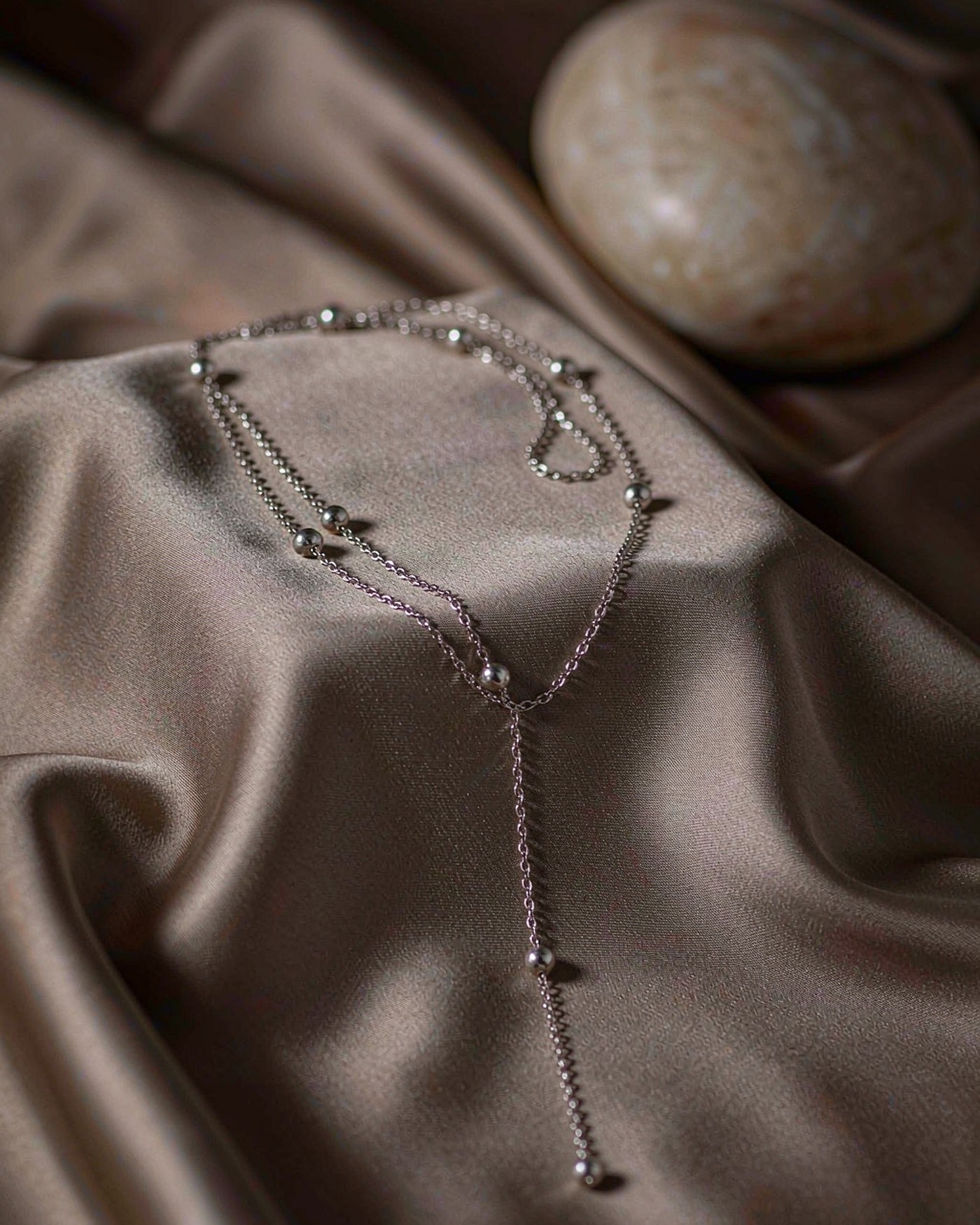
A lariat is a necklace with no clasp and no fixed front. Instead of a closed loop with a pendant soldered to the middle, it is a long chain whose ends hang free, so the wearer decides where the drop sits and how low it falls. That single structural difference changes how the piece behaves: it moves, it draws a vertical line down the body, and it looks slightly undone in a way a pendant cannot.
The name comes from la reata, Spanish for the rope used to tether an animal — the same root as lasso. The shape arrived in fashion jewelry through the sautoir of the 1920s and has been revived roughly every twenty years since.
What Makes a Necklace a Lariat
The defining feature is not length and not the tassel. It is that the two ends are separate.
A lariat can be tied, looped once through itself, or left open with one end hanging lower than the other. Some versions use a sliding bead or a small ring to hold the drop in place; others simply rely on the weight of the ends. A tassel lariat adds a tassel, a bead cluster or a single charm to the bottom of the drop, which gives the eye something to land on.
Length is usually 50 cm or more, because the design needs enough chain to hang past the collarbone. The beaded lariat necklace in this collection runs 51 to 60 cm and weighs 2.5 g, which is light enough that the drop stays where you put it instead of drifting.
Lariat, Sautoir, Y Necklace, Tassel Necklace
The four terms get used interchangeably in shops, which makes buying confusing. They are not the same object.
| Style | Structure | How it sits | Best with |
|---|---|---|---|
| Lariat | Long chain, two free ends, no fixed pendant | Tied or looped; drop is adjustable | Crew necks, open shirts, knitwear |
| Sautoir | Very long chain, often with a tassel or pendant at the end | Hangs below the bust or is doubled | High necklines, evening wear |
| Y necklace | Closed chain with a short drop fixed at the centre | Drop position is set by the maker | V necks, scoop necks |
| Tassel necklace | Closed chain with a tassel hanging from the centre | Fixed, usually at the collarbone | Plain dresses, simple tops |
The practical difference is control. A Y necklace decides where the drop falls. A lariat lets you move it up or down by a few centimetres, which is the reason it flatters more necklines.
Why the Vertical Line Works
A lariat creates a narrow V from the shoulders to a single point. That line does three useful things at once.
It lengthens the neck by continuing the line of the throat downward rather than cutting across it. It gives a round or square face a vertical counterweight. And it fills the empty space left by a plain top without adding width at the shoulders, which is exactly where a short chunky necklace tends to add it.
The effect is strongest when the drop sits between the collarbone and the sternum. Above that it reads as a choker with a tail; below it starts to interfere with the neckline of the garment.
Four Ways to Wear One
Centred drop. Loop the chain once and let both ends hang together at the middle. This is the most formal version and the closest a lariat gets to a pendant.
Offset drop. Leave one end longer than the other and let the tail sit slightly to one side. This is how the piece is usually photographed, and it is the more modern look. The asymmetry keeps the eye moving.
Knotted. Tie the ends loosely at the length you want. A single overhand knot is enough; a double knot is hard to undo and puts a crease in the chain. Keep the knot above the tassel, not below it.
Doubled. Wrap a longer lariat twice around the neck and let the remaining length hang. This turns one piece into a layered look, which is useful when traveling with a single necklace.
Getting the Length Right
Fifty-one centimetres sits just below the collarbone on most adults; sixty lands in the middle of the chest. Because a lariat is adjustable, the number matters less than the proportion between the drop and the neckline.
As a rule, the drop should end at least two fingers’ width below the point where the neckline meets the chest. Any higher and the tail disappears into the collar; any lower and it starts to compete with a print or a seam.
Height changes the math. On a shorter frame, 55 cm already reads as a long line; on a taller frame the same length looks like a standard pendant. If you are between sizes, choose the longer option and knot it shorter when needed.
What to Wear It With
The lariat is a crew-neck piece. It also works over an open-collar shirt, where the two ends fall inside the opening and frame it, and over a fine-knit sweater, where the texture of the chain contrasts with the wool.
On a V neck it competes with the neckline, since both are making the same shape. On a strapless or off-shoulder dress it needs a very long drop to look deliberate. The safest pairing is a plain surface: a white tee, a linen shirt, a slip dress with no pattern.
What to Avoid
- Statement earrings. The lariat already draws a line down the body. Large earrings split the attention and make the neck look busy.
- Busy prints. A floral or striped top hides the chain, and the drop reads as a stray thread.
- Two long necklaces. One vertical line is elegant; two parallel lines look like an accident.
- Scarves. Wool and silk both catch a fine chain, and the scarf will win.
The Beaded Version: Texture Without Sparkle
Most lariats are plain chain. A beaded one changes the character of the piece: instead of a bright line, you get a rhythm of small round beads spaced along fine links, which reads as texture rather than shine.
That makes it easier to wear during the day and easier to combine with a watch or a bracelet, since there is no stone competing for attention. The beads also add just enough weight to keep the drop hanging straight — at 2.5 g the necklace stays put through a full day without pressing on the back of the neck.
If you want a lariat with more movement, a pearl tassel necklace puts a cluster at the end of the drop, so the piece swings when you turn. A mother-of-pearl tassel necklace does the same with a flatter, more reflective finish.
Clasps, Sliders and What Holds the Drop
An open-ended lariat stays in place through friction: the chain passes through a ring, a bead or a knot, and gravity does the rest.
Sliding beads work well on smooth chain and badly on rough or beaded chain, because the bead cannot pass the beads. If the design uses a slider, check that it moves with a light pull and stays where you leave it. If it slides down on its own, the drop will end up at the lowest point of the necklace within an hour.
On a beaded lariat with a fixed tail, the drop position is set by the maker. That is less adjustable but more reliable, and it is the better choice if you do not want to think about the necklace during the day.
Care
Sterling silver lariats fail in two places: the chain kinks, and the tassel bends.
- Store it hanging or coiled loosely in a pouch. A tight coil puts a permanent bend in a fine chain.
- Fasten the ends together before storing, or the two tails will find each other and knot.
- Put it on after perfume and lotion have dried, and take it off before swimming or showering.
- Wipe with a dry soft cloth after wearing; polish with a silver cloth when the surface dulls.
- Do not pull a knotted chain tight. Work the knot open with a pin instead of tugging the two ends.
Buying Checklist
- Stated length in centimetres and inches. “Long” is not a measurement.
- Weight, if given. Under 5 g hangs softly; over 15 g pulls the drop straight and can feel heavy by evening.
- 925 silver on the chain, not only on the tassel.
- A drop that ends in something. A bead, a tassel or a charm gives the line a finish; a bare chain end looks unfinished.
- No sharp edges on the beads. Run a finger along the strand in the shop, or read the reviews if you are buying online.
The Short Answer
A tassel lariat is a long, open-ended chain with a weighted drop, worn centred, offset, knotted or doubled. It suits plain necklines, elongates the neck and gives you control over where the line ends. Choose 51 to 60 cm, keep the rest of the neck bare, and treat the drop as the only decoration the outfit needs.
Related Reading
- How to Layer Necklaces Without the Tangle
- How to Wear Chinese-Style Jewelry Without a Costume Look
- Chinese Coin Necklace: Meaning, History and How to Wear It
- How to Style Moonstone and Star Jewelry Every Day
Browse the full collection of long silver chains and tassel necklaces. Long drops, fine links and quiet layered pieces, all in 925 silver.