

Blog
How to Wear Chinese-Style Jewelry Without a Costume Look

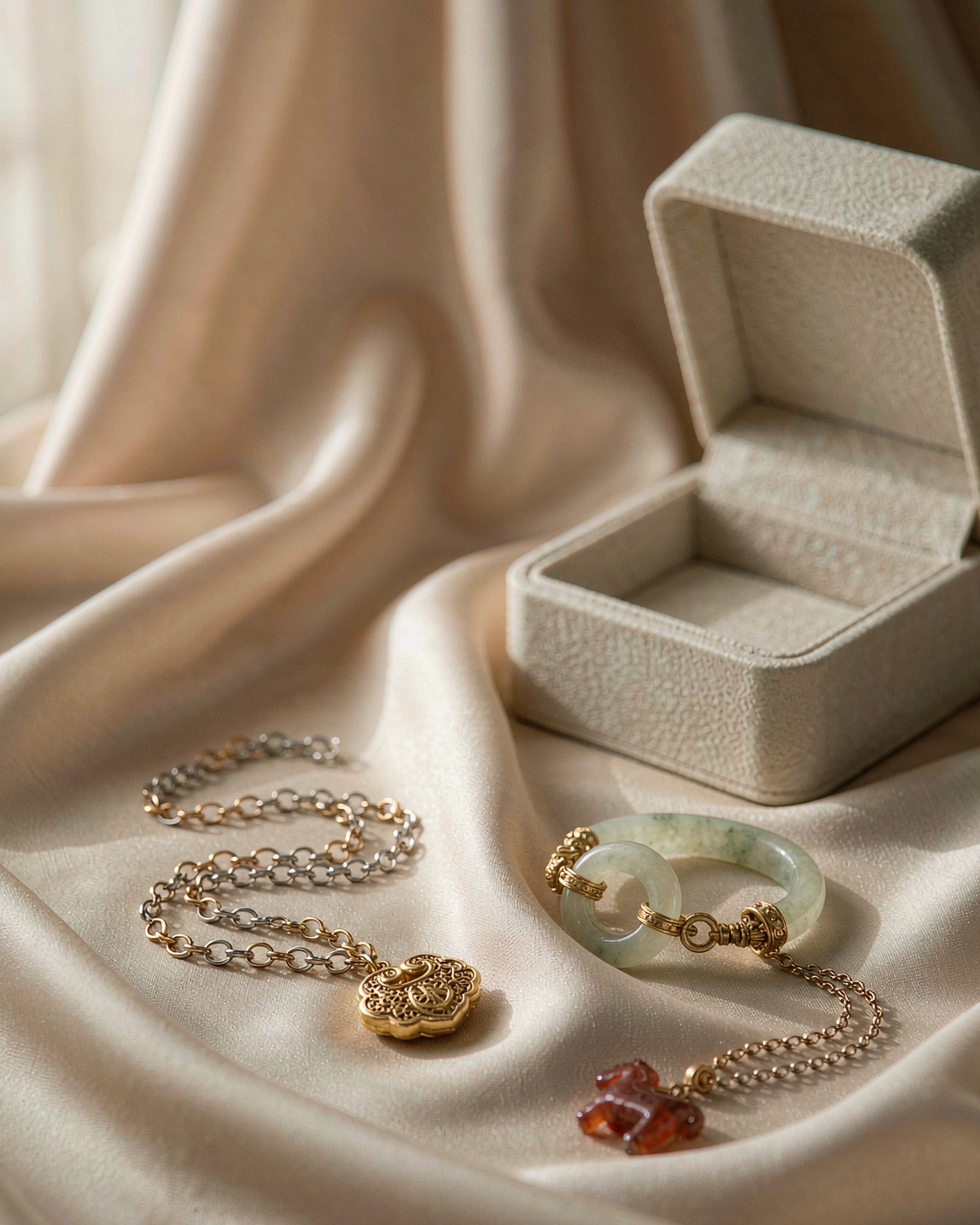
There is a narrow gap between wearing Chinese-style jewelry and wearing it as a costume. The pieces themselves are rarely the problem. What tips an outfit over the line is almost always context: too many symbols at once, the wrong scale against a neckline, or a modern wardrobe that fights the object instead of framing it. Get those three things right and a jade peace buckle reads as quiet luxury rather than tourist souvenir. Here is how to wear the style with a straight face, and how the symbols actually behave once they leave the display case.
Why It Can Read as Costume
Chinese-inspired pieces carry a lot of visual information. A peace buckle has an outline, an engraved pattern, often a secondary motif inside it, and a metal finish on top of that. That density is what makes the design interesting, and it is also what makes it loud. Western styling habits make it worse: we are trained to add a watch, a couple of rings, a layering chain and a statement earring, and the result is a pendant competing with five other objects for attention.
The fix is not to dress down or to hide the piece. It is to treat it as the single object the outfit is built around — the way you would treat a large sculptural earring, or a printed silk scarf.
Rule One: One Symbol Per Outfit
Pick a single meaningful motif and let everything else be neutral in meaning. A peace buckle in the morning, a plain chain in the afternoon. If the necklace is a lucky coin, skip the evil-eye bracelet and the hamsa ring; mixing traditions does not read as worldly, it reads as a market stall.
This applies within the Chinese vocabulary as well. A ruyi lock, a coin, a jade gourd and a zodiac animal are four different sentences. Wearing two of them is a conversation; wearing all four is noise.
Rule Two: Let the Neckline Set the Scale
Almost all of these pendants sit deliberately high. The sterling silver peace lock pendant with its 14K gold-tone Ruyi charm hangs on a 40+5cm chain, which lands at the collarbone on most women, and the extra five centimetres exist so you can drop it a notch when a neckline demands it. That short length is a styling advantage: it leaves the chest free and keeps the pendant in the frame of an open collar.
With a high crew neck, a short chain disappears under the fabric or bunches at the throat. Either choose a piece that hangs below the collar line, or wear the neckline open — an unbuttoned shirt, a V, a scoop, a square neck. Boat necks and turtlenecks work best with a longer drop or with a bracelet as the focal point instead.
Rule Three: Commit to One Metal Tone
Two metal families run through this style: bright white metal, and warm gold-tone plating over silver. Both are legitimate, but they age differently against skin and fabric. Warm gold-tone flatters cream, camel, olive, rust and anything with a matte texture. White metal looks sharper against black, grey, navy, white poplin and denim.
Choose one per outfit. A gold-tone pendant next to a white-metal watch and silver hoops splits the eye and makes every piece look slightly accidental. If you love both, separate them by day: gold on Monday to Thursday, white metal on the weekend.
Rule Four: Keep the Clothes Quiet
The single most effective styling move is a plain, well-cut garment. A white cotton shirt, a fine-gauge knit, a black crew, a dark blazer, raw denim. Texture is welcome — linen, brushed wool, silk — but pattern is not. Florals, ties, checks and graphic prints all compete with engraved metal.
This is where jade earns its reputation. A Hetian jade peace buckle bracelet with an 18K gold-color finish is a soft, opaque green that reads almost like a stone in a piece of architecture — it needs a calm background to register. Put it against an oatmeal knit or a white shirt and it looks expensive. Put it against a printed dress and it vanishes.
Rule Five: Layer, Don’t Stack
Layering is the one place where a coin pendant does more work than a symbolic charm, because its shape is simple. The sterling silver coin pendant on a slim O-chain was designed for it: a round pendant with a square center, in either rose gold tone or white gold tone, sitting close to the collarbone so a second, longer chain can pass underneath without tangling.
Two chains is the ceiling for this look, and they should differ in length by at least five centimetres. Three chains plus a pendant plus a charm bracelet is the exact combination that turns a considered outfit into a costume.
What the Symbols Actually Mean
Knowing the vocabulary keeps you from mixing messages by accident.
- Peace buckle (ping an kou). The smooth round disc with a hole in the centre. The name translates as “safety” or “peace”, and it is traditionally given as a protective gift — the shape itself, continuous and unbroken, carries the meaning.
- Ruyi. Literally “as you wish”. A cloud-and-sceptre motif used on locks, clasps and pendants, associated with things going the way you hope.
- The coin. A round disc with a square hole, the shape of old Chinese currency. The round sky and square earth pairing made it a symbol of prosperity and of things being in order.
- Fu. The character for fortune or blessing, often engraved on buckles and clasps alongside a ruyi outline.
- Jade. In Chinese thought jade is associated with virtue and protection rather than with decoration alone, which is why it is so often paired with a peace buckle rather than worn as a standalone stone.
Three Outfits That Work
Workday. White poplin shirt, sleeves rolled, charcoal trousers, no other jewelry except the peace lock pendant and small studs. The gold-tone finish warms up an otherwise cold palette, and the collarbone length keeps it inside the collar.
Weekend. Oatmeal knit, straight-leg denim, the jade peace buckle bracelet on the wrist. Nothing at the neck. This is the outfit that makes the style look inherited rather than purchased.
Evening. Black silk or a fine knit in deep navy, one longer chain with the red agate horse pendant and its peace buckle detail as the only colour in the look. Red agate is a saturated, slightly earthy red — it holds its own against black without needing anything else.
Where to Start
If you are buying your first piece, start with the motif you understand rather than the one that photographs best. A peace buckle is the safest entry point because the shape is legible at a distance and the meaning is easy to explain. Build the rest of the outfit around it, keep the metals consistent, and the piece will stop looking like a costume and start looking like something you have always owned.
Related Reading
- Chalcedony, Jade and Aventurine: A Stone Guide
- What Is a Tassel Lariat Necklace, and How Do You Wear One?
- Chinese Coin Necklace: Meaning, History and How to Wear It
- How to Layer Necklaces Without the Tangle
Browse the full collection of Chinese-inspired silver jewelry. Coin pendants, peace-lock charms and jade drops made for everyday wear.
One thought on “How to Wear Chinese-Style Jewelry Without a Costume Look”