
Blog
Chalcedony, Jade and Aventurine: A Stone Guide

Most people who say they do not like green stones are thinking of one particular green stone they saw once and did not trust. That is fair. The market uses a handful of names loosely, and the same word can sit on a pale, milky bead and on a deeply saturated one with nothing in common but colour. This guide separates them by what you can actually see, so the next piece you buy is the one you meant to buy.
Four Names, Three Different Things
Chalcedony and agate are the same mineral described two ways. Aventurine is a different stone that happens to share a colour family. Jade is not one mineral at all but two, sold under a single word.
Chalcedony: The Quiet One
Chalcedony is a form of quartz with a very fine crystal structure, which is why it looks smooth and slightly waxy rather than glassy. It comes in white, grey, blue and a range of greens. When the stone grows in visible stripes, the trade calls it agate; the banded and the unbanded material are the same family, judged on different things. Agate is valued for its pattern. Chalcedony without bands is valued for evenness, so a good piece has a calm, uniform surface and no dull patches where the polish drops off.
White chalcedony reads almost like frosted glass and takes on the colour of whatever is next to it, which makes it the easiest stone to wear with cool palettes, denim and plain white cotton. Green chalcedony is deeper and a little more old-fashioned in the best sense. The teardrop chalcedony pendant uses one round bead at the heart of a pavé-outlined drop, offered in a green or a white stone on a 40+5cm chain that settles at the collarbone. Note how the setting works: the stone is small and the metal does the framing, so the piece stays quiet even in the green option.
Aventurine: The One That Sparkles
Aventurine is quartz too, but with tiny reflective inclusions scattered through it. That is the whole difference. Hold it in flat light and it is a soft, slightly cloudy green; move it and a fine shimmer travels across the surface, an effect jewellers call aventurescence. It is not a faceted sparkle and it is not a metallic sheen. It is closer to the way frost catches light.
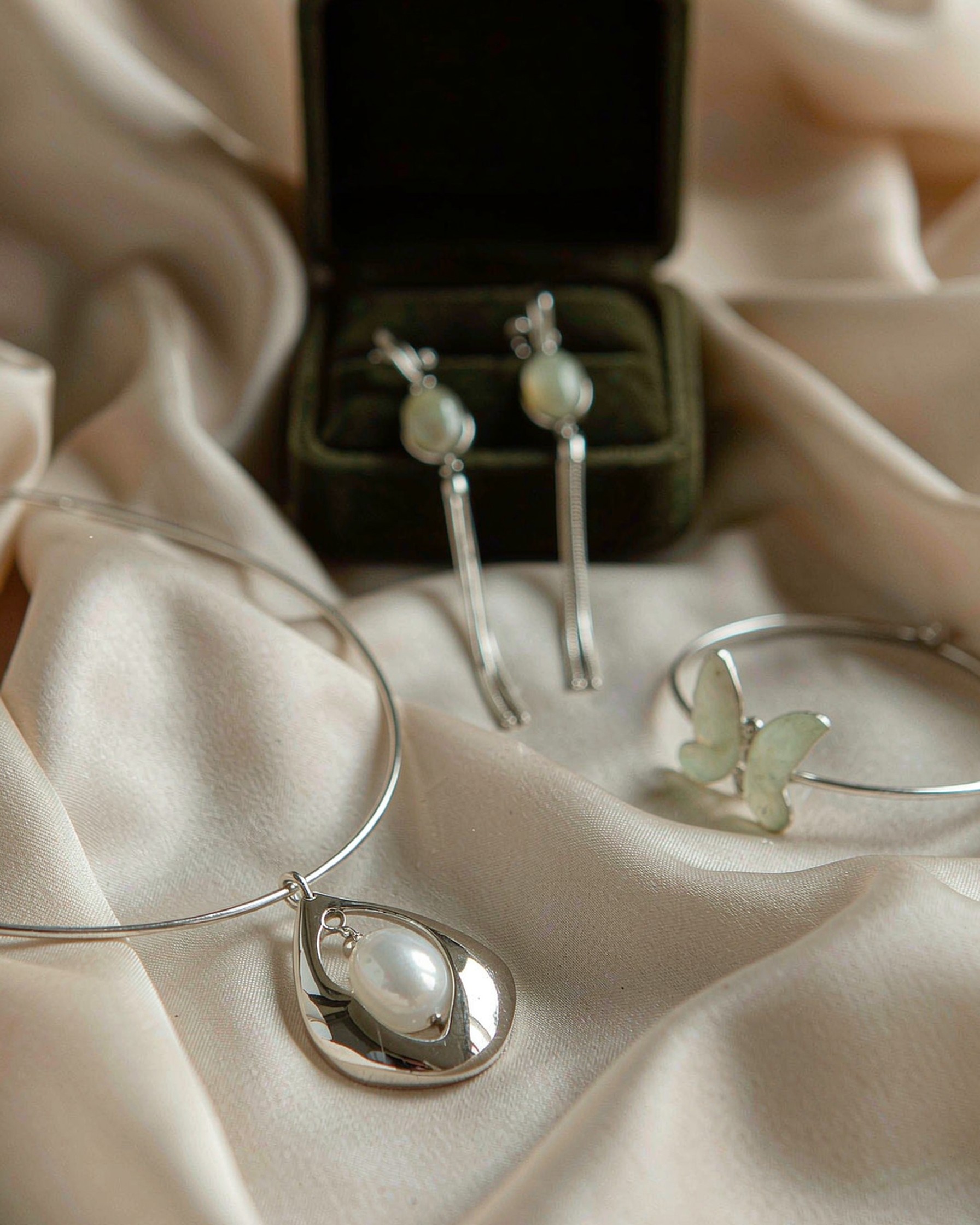
Because the shimmer only appears in motion, aventurine is at its best in pieces that move with you — drops, tassels, pendants on a fine chain. Set it in a rigid shape and you lose the reason to choose it. The aventurine butterfly drop earrings pair the stone with a long fluid tassel in 925 sterling silver, which is exactly the right brief: the swing is what makes the material do its work.
Jade Is Two Stones, Not One
In the trade, jade covers nephrite and jadeite, two different minerals with different compositions that were grouped together long before anyone analysed them. Nephrite is the older material in Chinese jewellery and the one usually meant by Hetian jade; jadeite arrived later and tends to be more translucent and more vividly coloured. Neither is better in the abstract. They simply look different, and a seller who uses the word jade without saying which one is telling you very little.
Nephrite has a soft, oily lustre rather than a hard glassy one, and good pieces look lit from just under the surface. It also rewards simple shapes, because the appeal is the surface itself and not the cutting. The geometric Hetian jade pendant is built on that logic: a clean-cut green nephrite form in a plain silver setting on a 40+5cm chain, with the new Chinese styling kept to the proportions rather than to applied ornament.
What “African Jade” Actually Means
Here is the part most guides skip. African jade is a trade name, not a mineral name, and it does not refer to nephrite or jadeite. It is a green stone sold into the jade market under a geographic label, and quality varies enormously between batches. That does not make it a bad choice — it is often the most interesting green at a modest price — but it does mean you should judge the individual stone rather than the label. Look for even colour and a clean polish. A well-cut African jade can look richer than a mediocre piece of nephrite.
The green gourd pendant shows the honest way to use it: the pendant is set with a single stone, offered in African jade or white chalcedony, in either a white gold or a 14K gold finish, with a small bow at the top of the gourd. Because only one stone is used, there is nowhere for a weak batch to hide. You are looking at one cut surface and deciding on that.
How to Judge a Stone You Cannot Touch
Three things survive photography, and they are the three worth checking.
- Evenness. Good stone has consistent colour across the whole face. Blotches, pale margins and dark spots near the edge are the usual signs of a lower grade, and they are visible in a straight-on photo.
- Polish. The surface should look wet, not dusty. A dull sheen at the edges means the cut was rushed.
- The setting. A stone held by four thin claws costs less to make than one seated in a closed bezel, and it also snags. Look at how the metal meets the stone: a tight, even line is a good sign at any price.
Matching the Stone to What You Wear
White chalcedony is the most forgiving and disappears against pale skin, so it needs a darker garment or a gold-tone finish to register. Green jade and green chalcedony both warm up against cream, camel, oatmeal and olive, and they look their age against black. Aventurine is the only one of the group that behaves like an evening stone, because it needs movement and low light to shimmer. Red jade, when you find it, is a saturated accent and should be the only colour in the outfit.
Care That Actually Matters
None of these stones needs a cabinet or a ritual. What they need is to be kept away from perfume, hairspray and chlorine, wiped with a dry soft cloth before it goes back in the box, and stored so that harder pieces do not rub against them. Porous green stones absorb what you put on your skin, and no amount of polishing takes it back out. The silver will tarnish on its own schedule regardless; a dry airtight bag slows that down more than any liquid treatment.
Where to Start
Choose the colour you will actually wear, not the most valuable name on the list. White chalcedony for a light, cool wardrobe; green jade for warm, textured layers; aventurine if you want something that moves. Then check the three things above and ignore the label.
Related Reading
- How to Care for 925 Sterling Silver Jewelry
- Hypoallergenic Earrings: Which Metals Suit Sensitive Ears
- Moissanite vs Diamond: A Real Buyer’s Guide
- How to Wear Chinese-Style Jewelry Without a Costume Look
Browse the full collection of gemstone-set silver jewelry. Chalcedony drops, jade pendants and aventurine butterflies, all set in 925 silver.